Vesper

Vesper rebuilt the microphone from the inside out, replacing the power-hungry capacitive design that had dominated consumer electronics for two decades with a piezoelectric architecture that was rugged, waterproof, and capable of listening continuously on almost zero power.
Story
For the last twenty years, nearly every microphone in every consumer device — every smartphone, every earbud, every laptop, every voice-activated speaker — has used the same basic design. A flexible diaphragm vibrates over a perforated backplate. The capacitance between them changes as sound waves push the diaphragm. A chip reads the change and converts it to voltage. It's a clever bit of physics, it's been scaled to billions of units, and it works.
It also has hard limits that the industry quietly accepted because there was no alternative.
Capacitive MEMS microphones have a backplate, which means they have a hole. The hole lets sound in. The hole also lets water, dust, oil, sweat, and particulate matter in — which is why microphones in phones and earbuds fail, why smart speakers degrade in kitchens, and why outdoor and industrial deployments need elaborate (and lossy) waterproofing membranes. The capacitive design also requires constant biasing voltage to function, which means a microphone that's "always listening" for a wake word is also always burning power — a tax that gets paid in battery life on every wireless device. As voice became the primary interface for headphones, hearables, smart home devices, and edge AI, the limits of the underlying microphone became the limits of the product.
The interface to AI was getting more important. The component underneath it hadn't fundamentally changed since 2003.
The Opportunity: A New Physics for the Microphone
Piezoelectric materials produce voltage directly in response to mechanical stress — no diaphragm, no backplate, no air gap, no bias voltage. The physics had been known for decades. The hard part was manufacturing a piezoelectric film thin enough, uniform enough, and cheap enough to compete with capacitive MEMS at consumer-electronics scale. That required a new materials stack, a new fabrication process, and a CMOS-compatible architecture that could ship at hundreds of millions of units per year.
The next generation of always-on voice didn't need a smarter wake-word model. It needed a microphone built for the job in the first place.
Piezoelectric MEMS, Productized
Vesper spun out of the University of Michigan and built its piezoelectric MEMS platform into a commercial product line that delivered three structural advantages over every capacitive microphone on the market:
- Environmentally rugged by design. No backplate, no hole, nothing for water, dust, oil, or particles to get into. Vesper microphones survived dishwashers, sweat, jobsite dust, and outdoor exposure — categories where capacitive MEMS had always required compromises. IP57-rated audio in earbuds, microphones that worked through the lifetime of an outdoor sensor, smart appliances that didn't fail when something spilled on them.
- ZeroPower Listening. The piezoelectric design produced voltage from sound itself, which meant Vesper's microphones could remain in a dormant state drawing essentially no power, then wake the device instantly when a designated acoustic trigger arrived. For always-on voice systems — wake words, glass-break detection, industrial alarms — this was an order-of-magnitude improvement in battery life over capacitive always-listening designs.
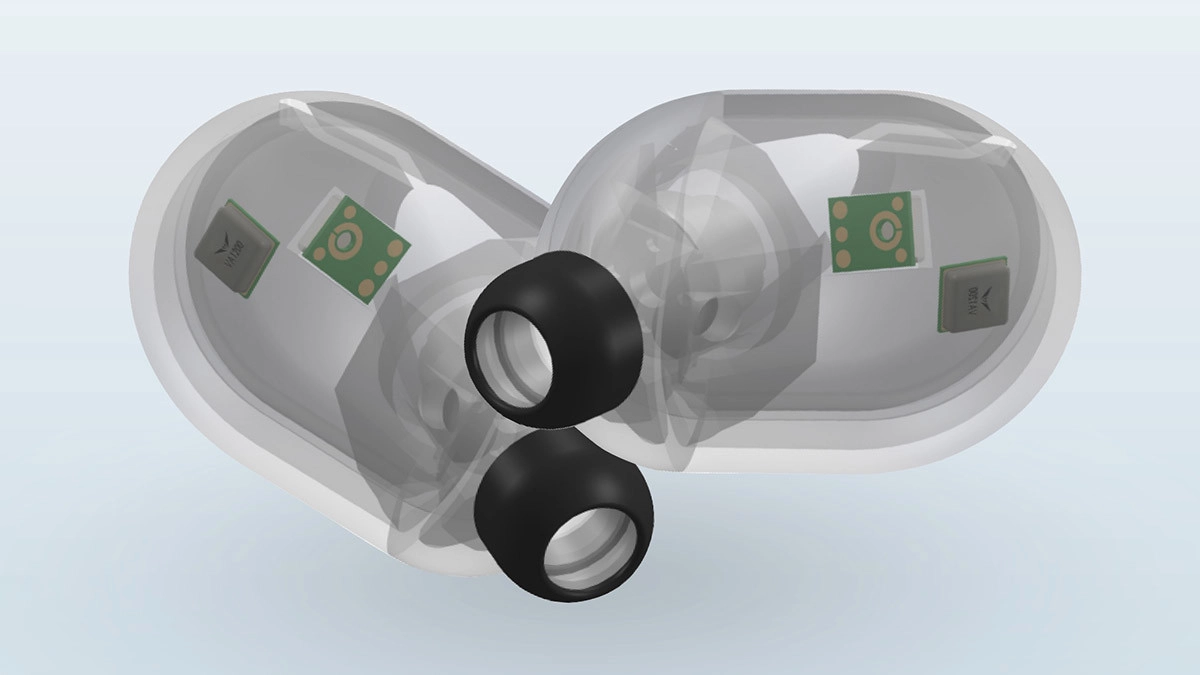
- Voice accelerometers for noisy environments. The VA1200, the world's first analog piezoelectric voice accelerometer, picked up the wearer's voice through bone conduction inside an earbud — filtering out wind, background noise, and crowd noise that defeats every standard microphone. Paired with a conventional MEMS microphone and sensor fusion, it became one of the foundational components inside the next generation of true wireless earbuds.
The customer roster validated the architecture. Vesper's microphones and sensors shipped into smartphones, active noise-canceling headphones, true wireless earbuds, smart home devices, edge AI products, and industrial and security sensors. The company raised $73M in total funding from a strategic-heavy investor base that read like a customer list — Accomplice, Applied Materials Ventures, Sands Capital, the Bose Ventures arm, the Amazon Alexa Fund, Gopher Asset Management, ITIC, World Peace Group, Unitrontech, and MegaChips. The 2021 financing round, led by Accomplice, was raised specifically to scale manufacturing from tens of millions of units per year to hundreds of millions — the volume threshold that turns a novel MEMS architecture into a real industry standard.
Why We Invested
We backed Vesper on three convictions, and they all played out:
- Voice was about to become a primary interface. The microphone was about to matter more than it had since the phone was invented. Wake words, always-on assistants, hearables, edge AI, and ambient computing all converged on the same component — and that component hadn't been rearchitected in a generation.
- The physics was real, and the team could ship it. Piezoelectric MEMS wasn't a research idea; it was an engineering problem of manufacturing. CEO Matt Crowley and the Vesper team had the materials depth, the foundry relationships, and the operating discipline to turn the architecture into a product that could ship at consumer-electronics volumes.
- The strategic gravity was undeniable. When the investor list includes Bose, Amazon Alexa, Applied Materials, and a half-dozen Asian electronics partners, the signal is unambiguous: the people who build the products that need this component were betting on the architecture. An acquisition by a platform owner like Qualcomm was always the natural endgame.
Vesper is one of the clearest examples in the Hyperplane portfolio of a thesis that took a decade to play out and paid off when it did. Voice became the interface. Always-on sensing became the default. Edge AI moved into every device. And the microphone underneath all of it — the one component that had to listen continuously, survive any environment, and barely sip power — became Vesper's.
Insights & News