Tive reaches five million trackers.
Story
Tive reaches five million trackers.
The founder’s journey behind the milestone, and why an AI-driven supply chain needs a reliable connection to the physical world.
Nov 11, 2026

Krenar Komoni has spent roughly a decade obsessed with one problem: knowing what happens to goods while they are in transit. We backed Tive at the pre-seed stage, when that problem was all the company had, and we have watched him stay locked on it through every stage since.
In October, Tive passed five million trackers sold. When Krenar marked the milestone publicly, he wrote less about the number than about what it took to get there: the sleepless nights, the disappointments, the persistence and the moments of joy. From where we sit as early investors, that persistence explains the chart better than any single number on it. Every customer Tive has won came from the same founder working the same problem, year after year, longer than most people would have stayed with it.
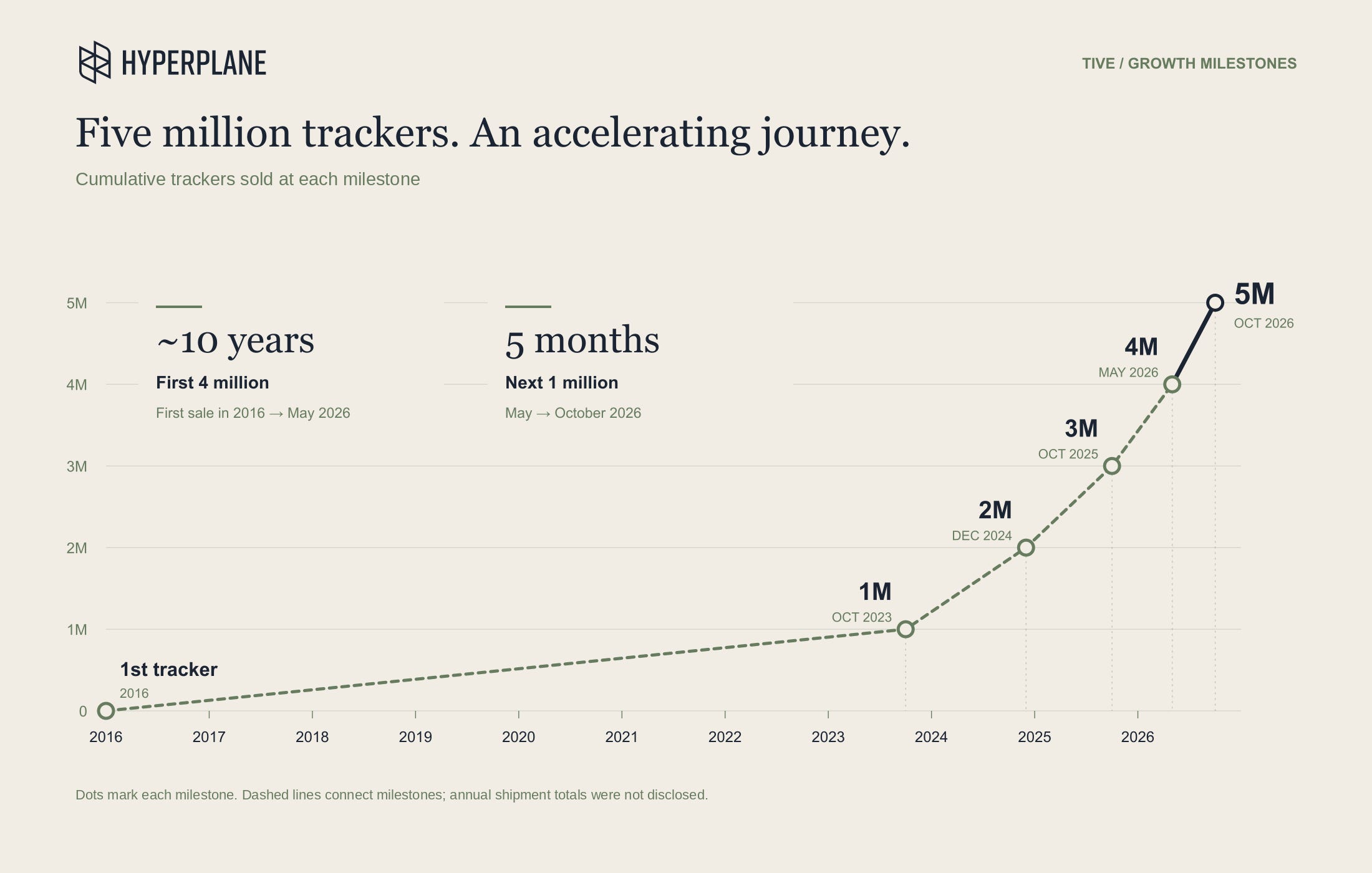
Tive sold its first tracker in 2016 and reached one million in October 2023. The second million took 14 months, the third took ten, and the fourth arrived seven months after that. The fifth came in five.
Put another way, it took roughly ten years to sell the first four million trackers and five months to sell the next million. The part of the curve that looks inevitable sits on top of years that didn’t.
What five million represents
Tive announced the milestone on November 3, after crossing it in October. Its trackers travel with the goods and report where they are and what condition they’re in, so a customer can act while the shipment is still moving.
Timing is the whole point. If you learn a temperature-sensitive shipment went bad when it arrives, you have very few options left. An alert mid-journey gives someone a chance to step in. What the customer is really buying is time to make a decision.
Tive now reports more than 1,500 customers, over 15 billion miles logged and 12 million real-time alerts. Those numbers show the scale of what Krenar and the team have built, but any single alert is only worth what the customer can do with it.
Getting that right takes more than a good sensor. The device has to work, the data has to arrive, and the person responsible for the shipment has to understand what happened and what to do next. A weak spot anywhere in that chain makes everything else less useful.
AI needs to know what is happening
Our post-AGI thesis starts with a simple question: if every company had access to equally capable intelligence, why would this one still win? We expect powerful models, open-weight and open-source included, to become widely available. The companies we want to own get more useful as that happens.
Tive is a concrete case. A model can reason about a supply chain all day, but it still needs current observations from the shipment itself. It can’t know for certain that a particular pallet just went over its temperature limit, that a container was opened, or that a truck stopped somewhere it shouldn’t have. Someone has to measure those events and get the information there in time.
Tive has spent years building the hardware, connectivity, and customer relationships that make those observations possible, and five million trackers is a measure of the reach it has earned. As customers hand more responsibility to AI agents, that connection to the physical world should become worth more.
You can already see the first steps. Tive’s workflow automations respond to defined events by escalating an issue, changing tracker settings, or creating a shipment record. Customers decide where automation makes sense and where a person should stay in the loop.
A foundation for more autonomous logistics
Over time, we think Tive can become the trusted source of shipment conditions that people and AI agents both rely on to run logistics. Picture an authorized agent that takes a live temperature alert, checks it against delivery requirements and carrier availability, and proposes a fix to the operations team. The intelligence could come from any number of models. The decision still depends on an accurate account of what is happening to the goods.
Getting there means Tive has to keep earning trust through reliable service and useful integrations. The business is worth more when customers depend on its data to make decisions and will pay for that dependability.
What makes Tive special to us is that it started this work long before AI agents were a mainstream idea. Krenar built around a customer problem that isn’t going away, and better intelligence gives him more ways to solve it.
This milestone takes us back to a lesson from our ten-year reflection: hustle and patience belong together. The willingness to keep building matters most in the years when the curve is still hard to see.
Krenar always gives credit to the people who did that work: the employees who showed up every day and the customers who trusted Tive with shipments that matter to them. That’s the part of the story we want to celebrate alongside the number.
Congratulations to Krenar and the whole Tive team. We’re proud to be part of the journey. On to ten million.