Biotia raises $9M to scale infectious disease diagnostics
Story
The oversubscribed financing will help Biotia scale its New York City laboratory, launch additional diagnostics in women's health, and expand into orthopedic diagnostics.
Hyperplane
Nov 17, 2026
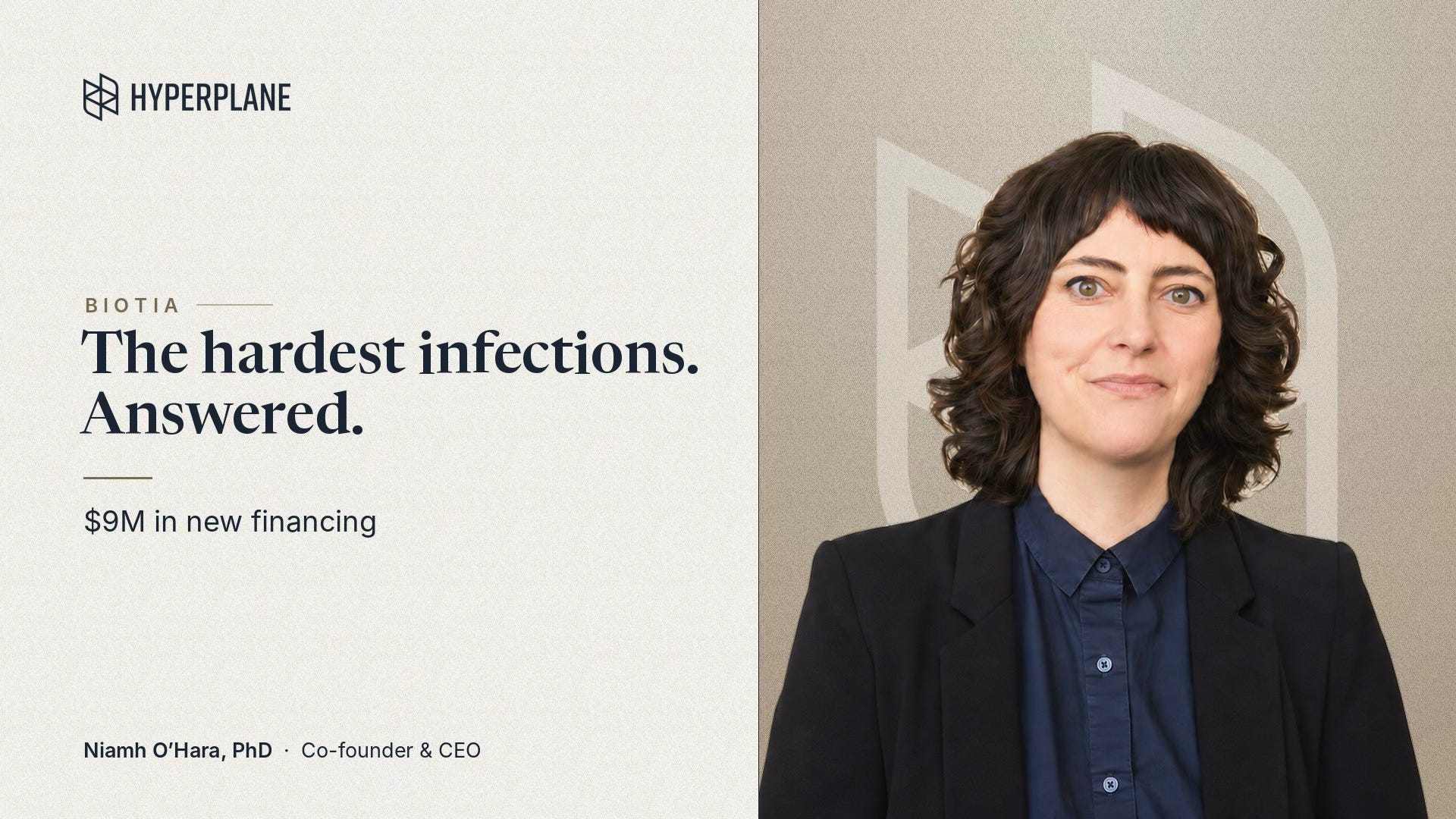
When we first met Niamh O’Hara, Biotia was research coming out of Cornell Tech with a big premise. Sequence everything in a clinical sample, use computation to make sense of it, and you can give physicians answers that standard tests miss. We backed Biotia at the pre-seed stage on that vision and on Niamh. Today its partners and collaborators include Mayo Clinic, Hospital for Special Surgery (HSS) and NASA, and its flagship test is available in all 50 U.S. states.
In October, Biotia closed an oversubscribed $9 million financing to scale what it has built. The capital will expand its CLIA-certified, high-complexity lab in New York City, add new women’s health diagnostics, and take the company into orthopedics. Its first commercial product, the BIOTIA-ID Urine Test, is built for recurrent and complicated urinary tract infections.
Finding what is causing the problem
Anyone who has had a stubborn infection knows the routine. You feel sick, you get tested, and the culture comes back with nothing useful. That happens a lot. Standard urine culture mostly catches common bacteria, and as many as one in three come back negative.
Biotia set out to fix that by pairing clinical metagenomics with AI. Metagenomics reads the genetic material in a sample to identify the organisms present, and the computational side turns that sequence data into information a clinician can use. Instead of waiting to see what grows in a dish, the BIOTIA-ID urine test can find 44 bacteria and fungi in one go, plus the genes that make an infection hard to treat. The AI behind it is Biotia’s BIOTIA-DX platform. When researchers worldwide competed to predict drug resistance, it came out on top two years in a row.
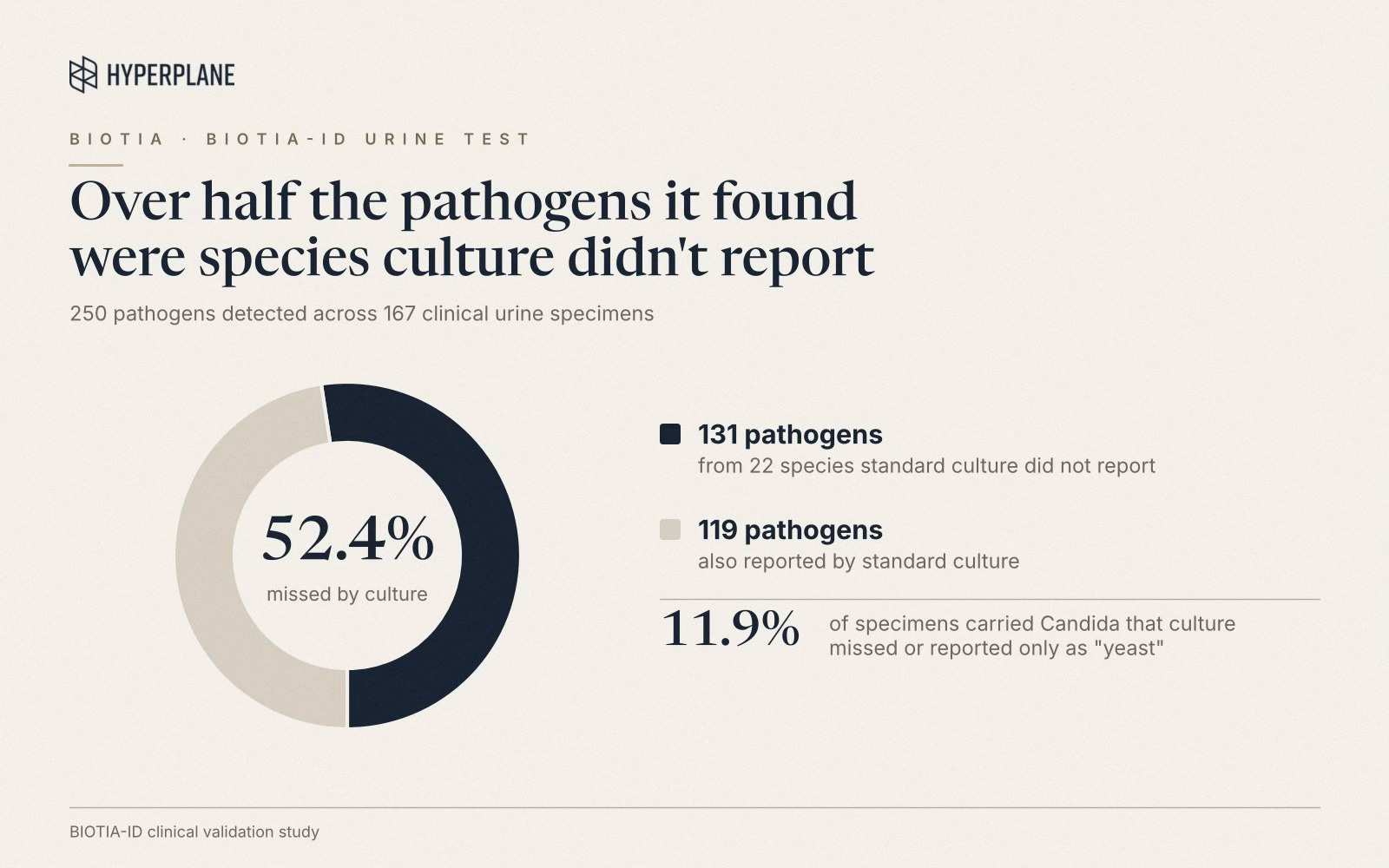
In Biotia’s validation study, 52.4% of the pathogens BIOTIA-ID found were species that standard culture didn’t report.
None of this happens without the people behind it. Niamh O’Hara is an evolutionary biologist by training who spent years in bioinformatics before deciding the research belonged in a clinic. She built the company at Cornell Tech with Chris Mason, a genomics professor at Weill Cornell Medicine who has published more than 300 papers. Together they took Biotia out of the lab and into their own CLIA-certified facility in New York City.
Intelligence still needs biological evidence
AI is getting smarter and cheaper every month, and soon everyone will have access to it. So in diagnostics, the edge goes to whoever can produce evidence you can trust. A model can help make sense of a sample once it’s been collected and processed. What it can’t do is invent an accurate reading of one patient’s infection. Someone has to actually measure it.
That’s the hard part. You have to choose what to measure, handle the sample right, prove the method works, and know where the results stop holding up. And even a great result is only part of the picture. Finding an organism is one clue a doctor weighs alongside everything else they know about the patient.
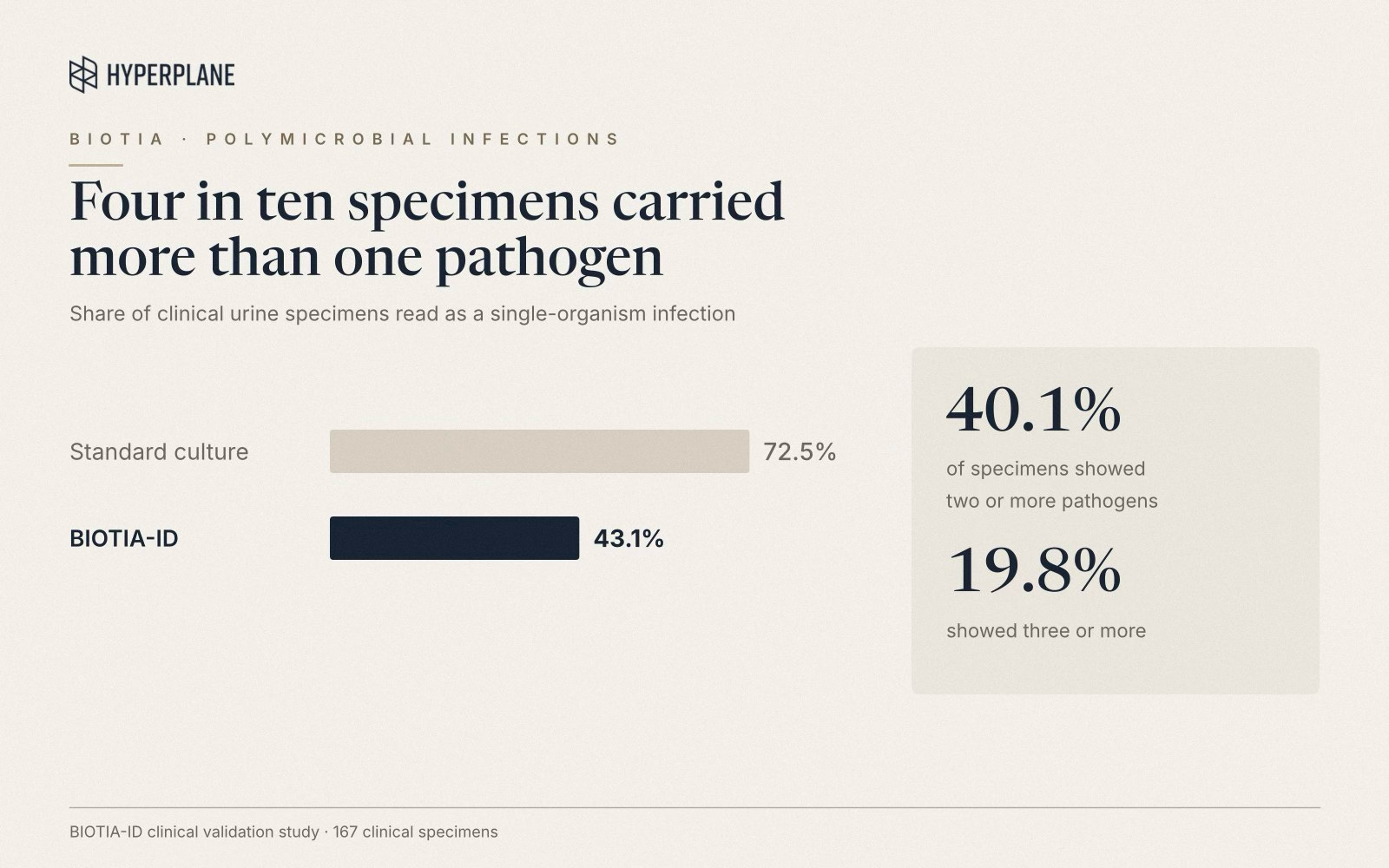
BIOTIA-ID found more than one pathogen in 40.1% of specimens, whereas culture most often reported a single organism.
That’s why Biotia fits our post-AGI thesis. We back companies whose assets get more valuable as AI gets cheaper and smarter. For Biotia, that’s its lab, its clinical evidence, and its relationships with the people who order and read its tests. You can’t spin those up overnight. They take time to build and discipline to keep.
Better models could make analysis cheaper and squeeze more out of messy samples. The company that wins is the one that turns that progress into something people can rely on. A doctor wants a result that makes sense and answers the question they asked. A patient wants to know what happens next.
Building a platform around difficult infections
The new money goes into three things: lab expansion, more tests in women’s health, and a push into orthopedics, where Biotia is already working with the Hospital for Special Surgery on joint infections. The company is also working on reimbursement. It has brought experienced healthcare operators onto its board, including VillageMD co-founders Tim Barry as a board member and Clive Fields as an observer.
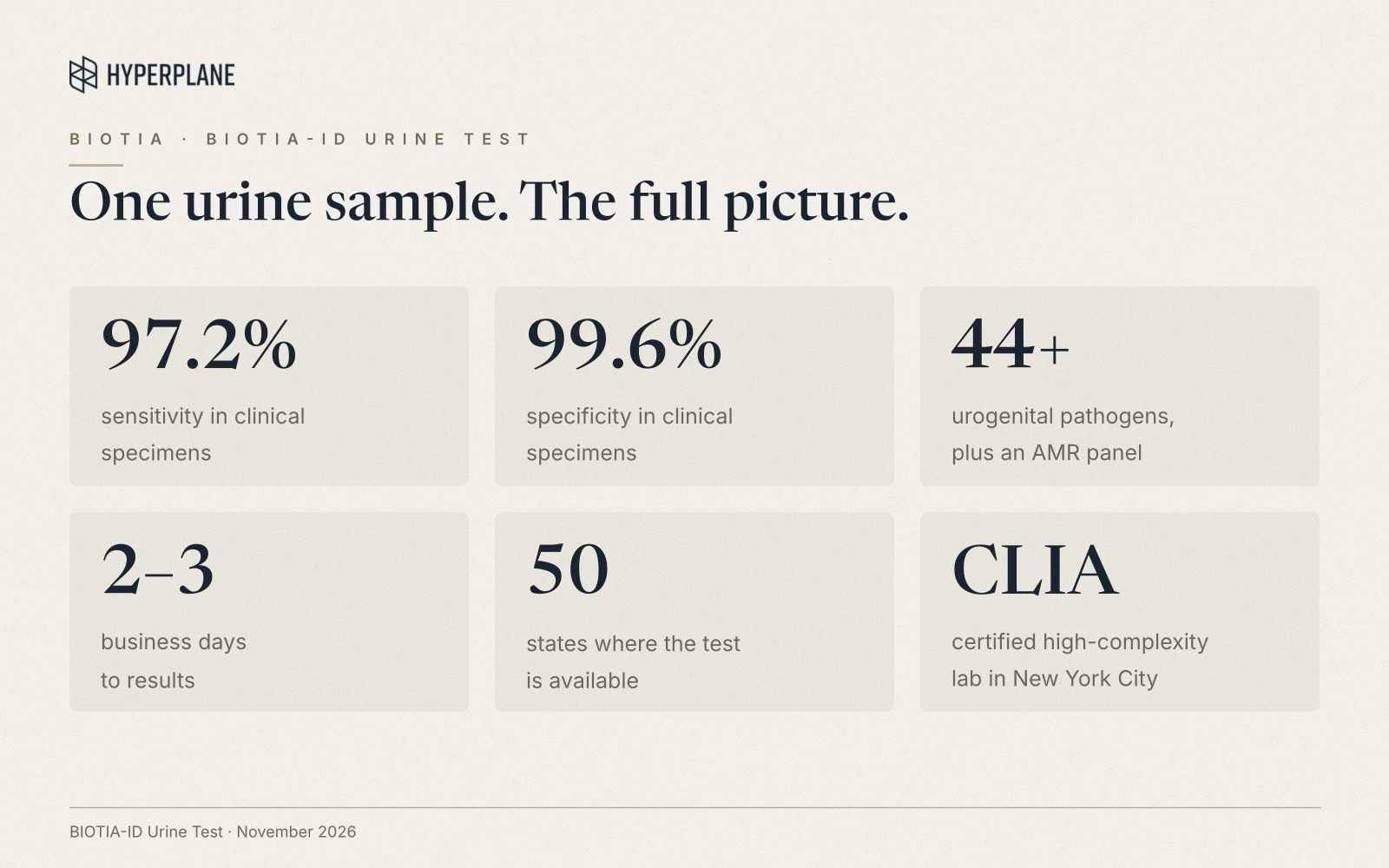
The BIOTIA-ID Urine Test at a glance.
Long term, we see a bigger business here. Hard-to-diagnose infections show up all over medicine. One company could handle the sample, the analysis, and the report across many of them, with each test backed by its own evidence. Every advance in AI would then make a service doctors already use even better.
The business works by giving clinicians useful answers often enough that they keep coming back. If Biotia can do that in more areas, its relationships and experience become the base it grows from. Cheaper analysis helps, but Biotia still has to prove its worth to doctors, patients, and insurers.
This is a hard company to build. Clinical validation doesn’t move at the speed of model releases. That’s why Niamh matters so much. She pairs deep scientific training with a stubborn drive to get the work into real clinics. She and the team are building where the evidence has to hold up for real patients and real decisions.
We think a world full of cheap intelligence will make the companies that produce trustworthy evidence, and get it to the people who need it, more important than ever. Biotia is building toward that role in infectious disease.
Congratulations to Niamh, Chris, and the whole team. To learn more, visit biotia.io.